
The creative lead for a mid-market apparel brand stares at a stunning five-second clip of a jacket billowing in a neon-drenched cityscape. It was generated in under a minute. It is perfect. The problem arises ten minutes later when the team tries to generate the second shot—the same jacket, the same lighting, but from a different camera angle. The AI produces a different shade of nylon, the neon shifts from magenta to scarlet, and the “model” now has a slightly different bone structure.
This is the “Entropy Gap.” In a vacuum, generative video is a miracle. In a production pipeline, it is often a liability. For creative operations leads, the challenge of the next 24 months isn’t finding a tool that can “make a video”; it is building a repeatable framework that tames the inherent randomness of these models to produce something that actually clears a brand’s legal and aesthetic hurdles.
The Entropy Problem in Generative Motion Pipelines
The fundamental tension in AI video production is the lack of determinism. Standard CGI pipelines are built on math and physics engines where 1+1
always equals 2
. If you move a light source three inches to the left, the shadows react predictably. Modern generative models are stochastic; they are probabilistic engines that predict the next most likely pixel.
This creates “visual drift.” When teams attempt to scale from a single “hero” clip to a 30-second narrative, the cost of regeneration churn becomes the primary bottleneck. Creative teams are currently burning through credits and, more importantly, hours of talent time chasing a specific “seed” or “random noise” state that matches the previous shot.
From an operational standpoint, we have to distinguish between “impressive” outputs—the kind that win engagement on social media for being weird or novel—and “deployable” assets. A deployable asset must maintain brand-specific physics, consistent character anatomy, and a stable color grade across a sequence. Currently, text-to-video prompts alone are insufficient for this task because they lack the “spatial memory” required for professional cinematography.
Benchmarking Variance Across the Model Ecosystem
Not all engines are built for the same type of failure. In our internal audits of the current landscape—testing models like Google’s Veo, Sora, and specialized engines like Nano Banana—the performance variance is dictated by the training data’s bias toward motion versus static fidelity.
Some models handle complex human movement with high temporal stability but fail at the “textural” level, creating a plastic, uncanny-valley skin tone. Others excel at atmospheric, slow-motion “vibes” but fall apart the moment a character attempts a complex task, like tying a shoe or picking up a glass.
There is also the documented phenomenon of model decay. As creative leads push for higher specificity through longer, more complex prompts, the visual fidelity often drops. The model begins to “overthink” the request, leading to flickering artifacts or what we call “prompt-weighting collapse,” where the AI prioritizes a minor detail (like the color of a watch) while hallucinating the background environment into an unrecognizable blur.
It is worth noting that we still lack clear data on how these models will perform under heavy fine-tuning for specific IP. While we can speculate that LoRA (Low-Rank Adaptation) training will eventually stabilize brand assets, the current reality for most teams is a messy process of trial and error.
The Workflow Bridge: From One-Shot to Iterative
To solve the consistency problem, production-savvy teams are moving away from “one-shot” generation. Instead of asking an AI Video Generator to create a masterpiece from a single sentence, they are breaking the process into layers.
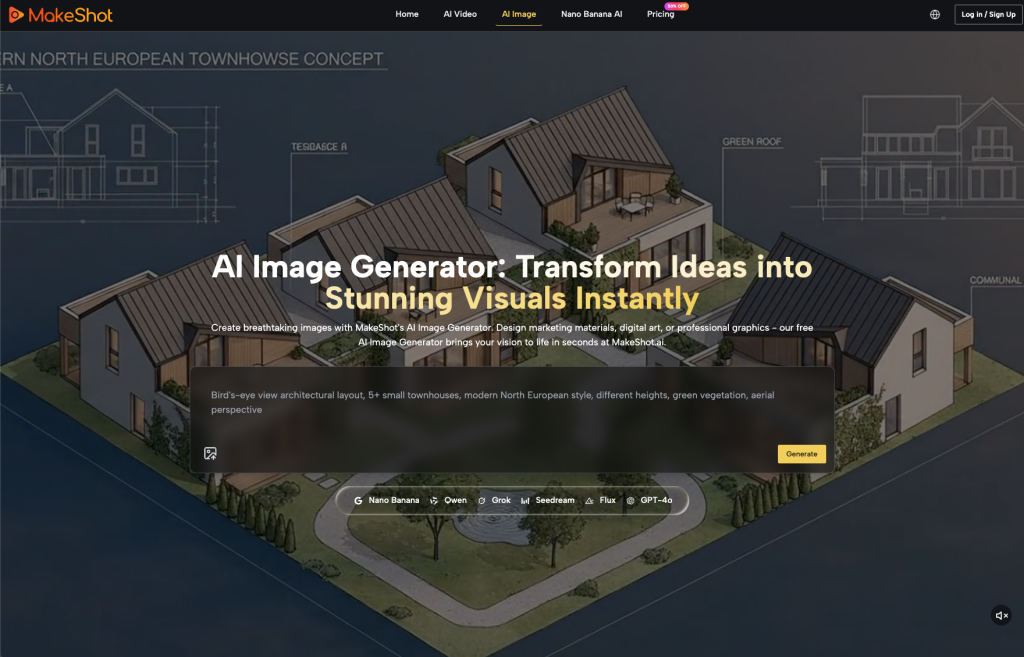
The most effective workflow currently involves anchoring the video in a high-fidelity static image. Using a tool like MakeShot’s Nano Banana allows a team to lock in the character, lighting, and environment in a still frame first. This “Image-to-Video” approach provides the model with a spatial reference point, significantly reducing the “morphing” effect seen in pure text-to-video outputs.
By centralizing these assets within a unified AI Video Generator, teams can reduce the friction of switching between disparate toolsets. When the base image, the upscaling, and the motion generation happen in the same ecosystem, the metadata—and theoretically the stylistic “DNA”—is more likely to persist. This isn’t just about convenience; it’s about reducing the variables that lead to aesthetic drift.
Temporal Instability: What We Still Cannot Conclude
Despite the rapid pace of development, there are significant “black boxes” in the technology that creative ops leads must respect. We are still in a period of extreme uncertainty regarding “directable motion.”
For example, asking a model to “make the character turn 45 degrees to the left and smile subtly” is still a high-variance request. More often than not, the AI will induce body-horror artifacts—limbs merging with torsos or facial features sliding across the skull—because the underlying architecture doesn’t “know” what a human skeleton is; it only knows what pixels usually look like when a human turns.
Because of this, generative video cannot yet replace high-end VFX for precise, frame-by-frame character interactions. If your campaign requires a character to interact with a specific product in a physically accurate way (e.g., pouring liquid into a specific branded bottle), current AI models will likely fail the “physics test.”
Furthermore, the industry is currently suffering from the “prompt engineering fallacy.” There is a belief that if you just find the “magic words,” the model will behave. In reality, the limitations are often baked into the model’s latent space. No amount of clever wording can force a model to generate something that isn’t represented in its training distribution or that exceeds its current temporal resolution.
Structuring the Human-in-the-Loop Quality Gate
Since we cannot rely on the AI to be its own editor, the role of the creative team shifts from “creator” to “curator” and “technician.” Scaling these pipelines requires a rigid quality gate.
First, teams should establish a “Minimum Viable Fidelity” (MVF) standard. This is a checklist of non-negotiables:
- Temporal Consistency: Does the background jitter or “breathe” unnaturally?
- Anatomical Integrity: Are the joints and extremities stable through the full range of motion?
- Brand Compliance: Does the lighting match the established brand style guide?
Implementation of a tiered feedback system is also vital. You must separate “prompt-level errors” (the user didn’t describe the scene well) from “model-level technical limitations” (the AI simply cannot render a bicycle wheel correctly). Trying to fix a model-level limitation with more prompting is a waste of resources. In those cases, the workflow must pivot to traditional post-production or “painting” over the AI frames.
The goal is to treat the AI Video Generator as a raw footage source—similar to a B-roll library—rather than a finished-product engine. This mindset shift allows teams to capitalize on the speed of AI while maintaining the control required for high-stakes commercial work.
The Pragmatic Path Forward
We are moving out of the “wow factor” phase of generative video and into the “operational” phase. The teams that succeed won’t be the ones with the most creative prompts, but the ones with the most disciplined workflows.
Consistency is not a feature of current AI models; it is a result of human-led constraints. By using platforms that integrate image-to-video logic and maintaining a healthy skepticism of what the models can actually “understand” about physics and brand identity, creative operations leads can turn a chaotic tool into a predictable asset.
The future of the AI Video Generator in professional spaces isn’t about replacing the director; it’s about giving the director a faster, albeit more temperamental, camera. Respecting those temperaments is the only way to scale without losing your brand’s soul to the entropy of the machine.
