The current market for generative AI is saturated with feature checklists that look remarkably similar. If you look at the landing pages for ten different image generators, you will see the same promises: high-resolution output, rapid generation, and intuitive interfaces. For creative operations leads tasked with building repeatable asset pipelines, these checklists are essentially useless. They describe the presence of a capability without quantifying its reliability, its failure modes, or its integration cost.
In a production environment, “it can do this” is a low bar. The real question is: “How much manual intervention is required after the AI finishes its work?” When we evaluate tools for professional use, we have to move past the novelty of the generation and look at the “cleanup latency”—the time and labor required to make an AI asset ready for public consumption.
The Checklist Trap: Why Feature Lists Fail Creative Ops
The standard feature matrix is a binary way of looking at a non-binary technology. Generative models are probabilistic “black boxes.” A tool might “have” an object removal feature, but if that feature consistently leaves smudges or hallucinates incorrect textures 30% of the time, it isn’t a feature; it’s a bottleneck.
Creative operations leads often fall into the trap of comparing tools based on their maximum potential rather than their average output quality. In a high-volume pipeline—say, generating 500 product variations for a social campaign—a tool that requires 40% manual retouching by a human designer is significantly more expensive than one that requires 5%, even if the former is cheaper or faster at the initial generation stage.
We need to shift the evaluation criteria from “Can it do this?” to “How predictably can it do this under load?” This requires a shift in perspective. Instead of looking for the best single image, we should be looking for the lowest variance in quality across a hundred images.
Model Diversity as a Risk Mitigation Strategy
One of the most significant risks in AI creative operations is model lock-in. If your entire workflow is built around a single proprietary model, you are at the mercy of that model’s specific biases and stylistic limitations. Every model has a “signature”—a way it handles light, skin texture, or composition—that eventually leads to “AI fatigue” where all assets begin to look identical.
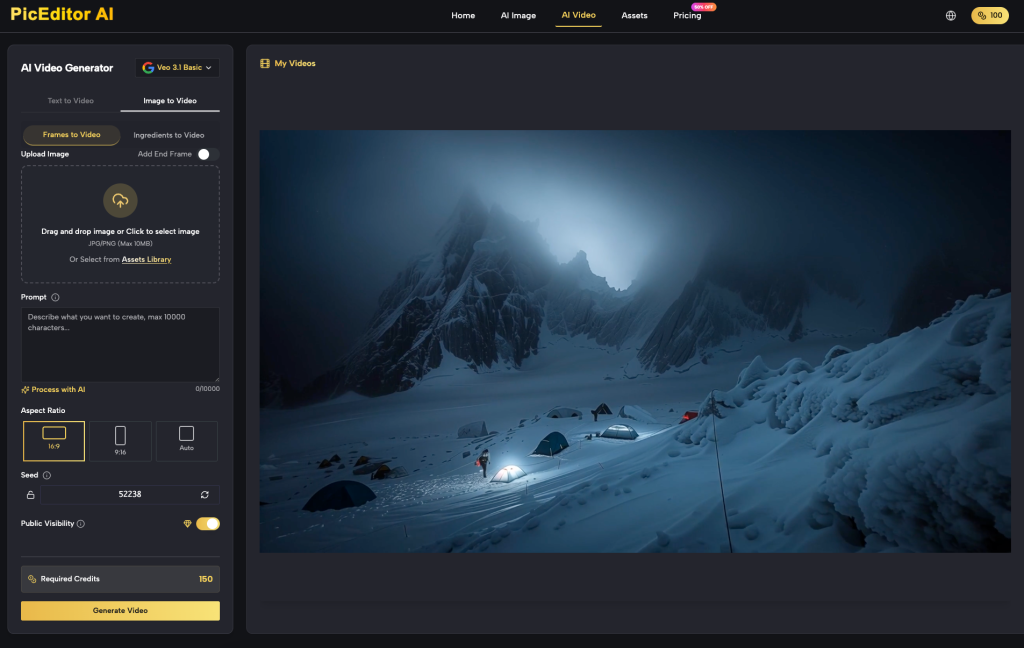
A more resilient approach involves utilizing platforms that offer model diversity. For example, a workflow that allows an operator to switch between Flux, Seedream, or Nano Banana within a single interface provides a hedge against stylistic stagnation. Platforms like PicEditor AI act as a curated marketplace for these engines, allowing teams to use Kling for video or Flux for high-fidelity stills without jumping between disconnected web apps.
This diversity is also a technical safeguard. Some models excel at photorealistic textures but fail at complex spatial reasoning. Others might handle typography better but struggle with human anatomy. By having access to a suite of models like Wan, Seedance, and Veo in one environment, a production team can route specific tasks to the engine best suited for the job, rather than forcing a “one size fits all” solution.
Benchmarking the Utility of an Integrated AI Photo Editor
The most common point of friction in an AI workflow is the “Alt-Tab” tax. This is the time lost when a creator generates an image in one tool, downloads it, uploads it to a separate editor to fix a small flaw, and then moves it to a third tool for upscaling. To minimize this, an integrated AI Photo Editor is not just a luxury; it is a production bridge.
When we benchmark an AI Photo Editor for a professional pipeline, we should be measuring three specific metrics:
- Object Eraser Precision: How well does the tool handle the “fill” after an object is removed? In professional work, we look for edge consistency and the preservation of the original lighting environment.
- Face Swap Fidelity: For localized marketing, does the tool maintain the skin tone and lighting of the target image, or does it look like a digital mask?
- Upscaling Latency: Does the integrated upscaler maintain the integrity of the original generation, or does it introduce “plastic” textures common in low-end AI models?
By keeping these functions within the same environment as the generator, you reduce the data fragmentation that occurs when assets move through multiple compression cycles across different platforms.
Predictability and Failure Modes: The Skeptic’s Guide
A truly production-savvy evaluation requires us to acknowledge where the technology currently falls short. There is a “Prompt-to-Precision” gap that remains a significant hurdle in the industry. For instance, even the most advanced AI Photo Edit currently struggles to offer 100% semantic control over highly specific anatomical details or intricate mechanical components. If you are generating assets for a watchmaker or a medical device company, the AI will likely struggle with the precise geometry of gears or surgical tools.
We must also identify “hallucination thresholds.” This is the point where a generative fill or an object eraser begins to degrade brand-specific geometry. For example, if you are removing a logo from a shirt, the AI might inadvertently change the weave of the fabric or the way the shadow falls across the chest. At this stage, it is uncertain whether any fully automated tool can perfectly replicate complex, real-world physics every time.
Because of these limitations, the goal is not to find a tool that is perfect, but to find one that is “predictably imperfect.” This allows creative ops leads to plan for a “human-in-the-loop” quality control layer. If you know that a specific model always struggles with hands but excels at backgrounds, you can allocate your human retouching resources more efficiently.
Workflow Consolidation: The Economic and Operational Case
Beyond the creative output, there is a hard economic case for tool consolidation. Subscription fatigue is a real problem for creative departments. Managing seat licenses for five different AI tools—one for generation, one for video, one for upscaling, and one for retouching—creates an administrative burden and increases the “cost per asset.”
Quantifying the ROI of a unified stack involves looking at the total time-to-delivery. If a team can go from a text prompt to a polished, upscaled, and edited image within one environment, they eliminate the hidden costs of file management and cross-platform compatibility issues. The efficiency of a unified stack that handles text-to-image and post-production in one place—as seen in the way PicEditor AI integrates its toolset—scales linearly with the volume of assets produced.
Furthermore, a consolidated workflow allows for better data security and asset management. When your team’s creative output is scattered across half a dozen experimental “beta” tools, you lose oversight of your intellectual property and brand consistency. A centralized platform provides a single point of truth for the creative team.
Final Judgement on Tool Selection
When evaluating generative media tools, do not be swayed by the most impressive cherry-picked example in a demo video. Instead, run a “stress test” using your actual brand constraints. Take a difficult prompt, run it fifty times, and measure the success rate. Use the internal AI Photo Editor to see if it can handle a complex object removal without destroying the underlying texture.
The industry is moving away from the era of “AI magic” and toward the era of AI utility. For the creative operations lead, the winner isn’t necessarily the model with the most “wow” factor; it is the platform that allows for the highest degree of predictability, model flexibility, and workflow integration. Prioritize tools that favor interoperability and give you a diverse range of models to choose from, as this is the only way to build a pipeline that is resilient to the rapid shifts in the generative landscape.
