Burnaby condo and strata winter-service information
A parking lot can look completely recovered from a winter event while a walkway twenty metres away remains slick.
That difference is easy to miss. Drivers see exposed asphalt, melting snowbanks, and dry tire tracks and reasonably assume conditions across the property are improving. Pedestrians may make the same assumption when they leave their vehicles.
But shaded walkway ice follows a different timeline.
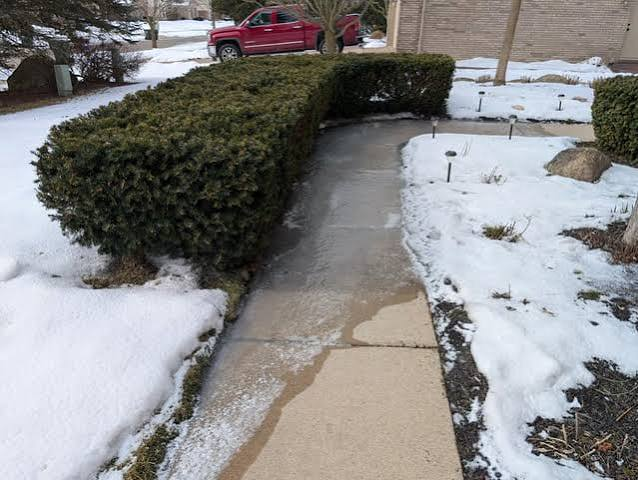
A sidewalk beside a tall building, beneath mature trees, along a retaining wall, or between closely spaced structures may receive little direct winter sunlight. The surface can remain cold enough to preserve compacted snow or refreeze moisture long after exposed pavement has warmed.
For strata properties, that creates an important operational distinction. Parking areas and pedestrian routes should not automatically be considered safe at the same time simply because they experienced the same weather.
Winter service needs to account for how each surface actually responds.
The Parking Lot Dries First—and Misleads Everyone
Open parking lots benefit from exposure that many pedestrian areas do not have.
Sunlight reaches dark pavement more easily, wind moves across the surface, and vehicle traffic can help disperse moisture. A sheltered sidewalk may experience almost the opposite conditions.
Sun Exposure Changes the Recovery Time
Direct solar energy can warm exposed pavement even when the surrounding air still feels cold.
Shaded concrete may receive only indirect warming. If a building blocks low winter sun for most of the day, the walkway can remain close to freezing while an open parking area becomes visibly dry.
This difference becomes especially important after snow has been mechanically removed.
A thin residual layer that disappears quickly from exposed asphalt may remain compacted on a shaded pedestrian route. Foot traffic can then polish that layer, making traction worse rather than better.
Dry Asphalt Creates False Confidence
People adjust their behaviour according to what they see.
Someone crossing a dry parking lot may walk normally, carry bags, check a phone, or stop watching the pavement carefully. When that person reaches an icy shaded section, the change in traction can be sudden.
The hazard is therefore partly visual.
A uniformly snowy property encourages caution. A mostly dry property with one persistent icy route can be less obvious—and potentially more surprising.
Shade Exposure and Surface Temperature
Winter maintenance decisions are often driven by air temperature, but the condition underfoot depends on the surface itself.
Concrete and asphalt do not necessarily warm and cool at identical rates. Thickness, colour, exposure, moisture, surrounding structures, and previous weather all influence how much heat a surface retains.
That is why shaded walkway ice may persist even when a nearby thermometer suggests conditions are improving.
The same property may contain several small thermal zones. An open entrance can become wet. A north-facing walkway can remain frozen. A covered stair landing may hold compacted snow. A parking lane exposed to afternoon sun may become completely dry.
Drainage complicates the pattern further.
Water from a sunny area can travel toward a colder shaded surface. Instead of the shade simply preserving old ice, it can receive new moisture from a section that has already begun thawing.
A winter plan should therefore consider exposure and water movement together rather than treating shade as a standalone issue.
The Storm Is Over, but the Walkway Isn’t
One of the most important times to inspect pedestrian surfaces is after the obvious weather has ended.
The property can look better by the hour while localized conditions quietly become worse.
Meltwater Can Move Into the Shade
Snow does not have to remain directly on a walkway for that walkway to develop ice.
A snowbank beside a parking area may begin melting during the day. Water follows the pavement grade until it reaches a cooler section beside a building or landscaped area.
Once there, evaporation may slow and the surface may remain cold.
If temperatures fall later, the moisture can refreeze across a pedestrian route even though no new precipitation occurred.
Snow-storage decisions therefore affect walkway conditions well beyond the original storm.
Evening Refreeze Resets the Risk
A surface that appears merely damp in the afternoon may require attention before the evening temperature drop.
That makes timing important.
Sending another plow would accomplish nothing if the snow has already been removed. The useful response may instead be an inspection, targeted granular treatment, clearing a drainage obstruction, or returning to a known cold zone before morning traffic.
Good winter service is not measured only by how quickly snow disappears. It is also measured by whether the property remains usable as conditions evolve.
Monitoring, Treatment, and Documentation
Persistent shaded areas should become known locations within the property’s winter plan.
A preseason walkthrough can identify walkways beside tall structures, covered entrances, tree-lined paths, stair approaches, north-facing sections, drainage crossings, and other places that repeatedly remain colder than surrounding pavement.
That information can improve both service efficiency and consistency.
Only Strata Snow Removal focuses specifically on strata properties, allowing recurring pedestrian and vehicle patterns to become part of the service plan. Strict capacity limits help protect response reliability during widespread events, while proactive dispatch supports follow-up when conditions change after the initial clearing.
Large salt reserves are particularly relevant during freeze-thaw cycles, when ice-control demand can continue even without substantial additional snowfall.
GPS and photo service logs add another layer. They can document which areas were inspected or treated and provide property managers with a clearer record of conditions during each visit.
The company’s damage repair guarantee and cancellation flexibility address other practical considerations, but the larger operational value comes from treating the property as a collection of different winter surfaces rather than one uniform site.
A Dry Parking Lot Can Hide an Icy Walking Route
The simplest improvement a strata council or property manager can make is to stop using the parking lot as the visual benchmark for the entire property.
Walk the pedestrian routes separately.
Check the sections that receive little sunlight. Look at where snowbanks drain. Inspect transitions between exposed and sheltered pavement. Pay attention to stairs, ramps, corners, and building entrances where residents naturally change direction.
Past experience should influence future service as well.
If the same walkway develops ice repeatedly, it should no longer be treated as an unexpected problem. It becomes a known winter priority that can be inspected earlier and managed more deliberately.
That is the practical lesson behind shaded walkway ice.
The end of snowfall does not mean every surface begins recovering at the same rate. Open pavement may warm, dry, and regain traction while a protected pedestrian route remains frozen for hours longer.
Winter safety depends on recognizing that difference.
Because the parking lot can tell you the storm is over while the walkway under the building is still holding on to it.
