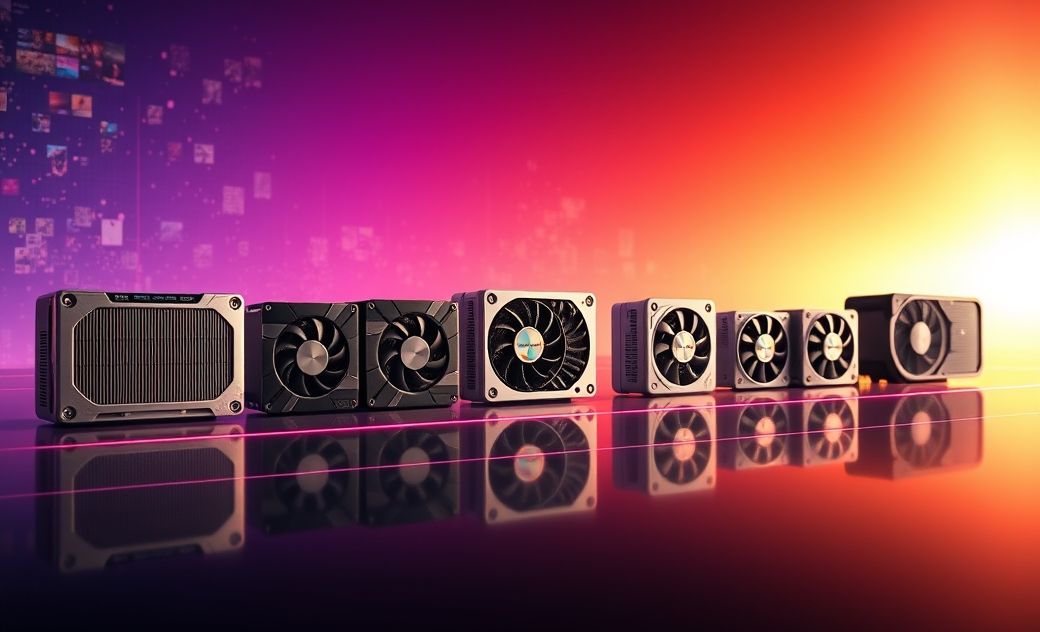
The evolution of Graphics Processing Units (GPUs) has been a cornerstone in advancing our technological landscape. From their modest beginnings as basic graphic cards to becoming powerhouses of computational ability, GPUs have revolutionized not only gaming but also fields like scientific research and artificial intelligence. In this article, we delve into this transformation and understand the crucial role GPUs play today.
Early Days of GPUs
In the early 1980s, the concept of GPUs as we know them today did not exist. Computers relied on CPUs to handle both computation and graphical tasks, which severely limited graphical performance. The first video cards, designed primarily for displaying text and basic shapes, laid the groundwork for future innovation.
The Introduction of 2D Renderers
As personal computing started to gain traction, the demand for better graphics grew. In response, 2D graphics accelerators were developed, allowing for smoother text and simple image rendering. These units offloaded graphical tasks from the CPU, marking the first step towards what would become the modern GPU.
The Birth of the Modern GPU
In the mid-1990s, major shifts occurred with the introduction of 3D graphics accelerators. Companies like Nvidia and ATI (now AMD) pioneered this change, revolutionizing how graphics were processed and displayed. The introduction of the first dedicated GPU, Nvidia’s GeForce 256, marked the beginning of hardware that could perform Transform and Lighting operations, cementing GPUs as necessary components for 3D graphics rendering.
GPU Architecture Advancements
Over the years, GPU architecture has evolved rapidly. Early models consisted of simple pipelines for graphics data processing. However, with time, these architectures became more complex, allowing parallel processing capabilities that began supporting a wide range of computations beyond mere graphics.
Programmable Shaders Revolution
One of the pivotal changes was the inclusion of programmable shaders. Shaders brought a new level of realism to 3D graphics by allowing developers to write custom programs for the GPU to execute, significantly enhancing visual effects and realism in gaming and visualization applications.
Current Applications of GPUs
Today’s GPUs are not just about rendering. They have evolved into general-purpose processors that support a wide variety of tasks. This transformation is primarily due to their highly parallel structure, which is ideal for handling large-scale computations efficiently.
Gaming and Entertainment
In the gaming industry, GPUs continue to push the envelope of visual fidelity, enabling photorealistic environments and dynamic lighting effects that mirror real-world physics. Ray tracing, a technique previously impractical due to computational constraints, is now becoming standard in gaming graphics thanks to modern GPUs.
Scientific Research and AI
Beyond gaming, GPUs have become integral in scientific research and artificial intelligence. They power simulations, data analysis, and machine learning models, drastically reducing computation times and enabling breakthroughs in fields like genomics and climate science.
The parallel processing capabilities of GPUs make them especially suited for AI tasks, handling operations for large neural networks used in machine learning algorithms with great efficiency.
The Future of GPUs
The trajectory for GPU technology continues to point upwards. Innovations such as quantum computing, advanced AI, and virtual reality will further push the boundaries. The integration of GPUs with other emerging technologies will likely lead to breakthroughs we are only beginning to imagine.
Moreover, as GPUs become even more energy-efficient, their use in mobile and wearable technology is expected to expand, bringing powerful computing capabilities to devices we use every day.
In conclusion, the evolution of GPUs from simple 2D renderers to critical components for modern computing illustrates the revolutionary impact they have on technology. As we look to the future, GPUs will undoubtedly continue to transform the landscape of both computing and graphics, further pushing the limits of what is possible.
